Annual Gathering
2010
Thursday 2 Sept - Sunday 5 Sept

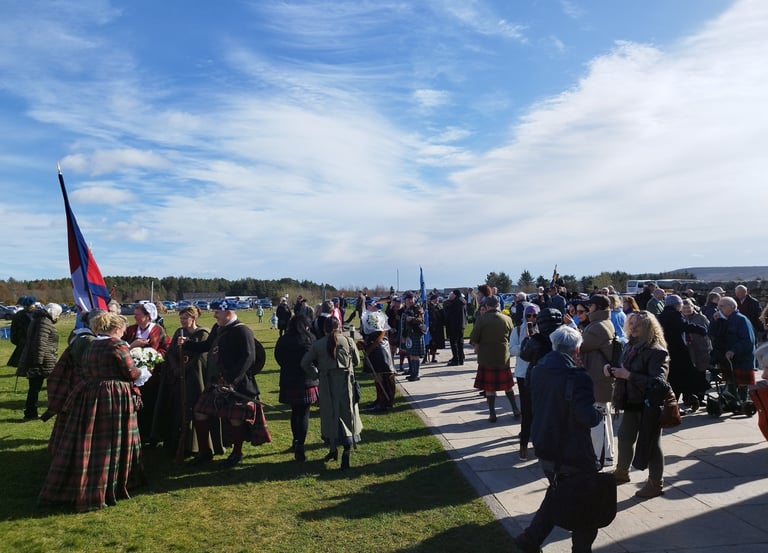
Before I tell you a little about the 2010 Gathering I thought it might be a good idea to encourage members to attend the Gathering next year. The 1745 Association has about 340 members and each year perhaps 10% attend the Gathering. That produces a reasonable sized group that can be managed effectively in terms of hotel accommodation, transportation during the event and entry to some of the smaller properties we may visit. Nonetheless we feel that we could manage a few more and we should like to encourage those of you who have thought about attending but so far have not done so to come along.
The
Gathering is for the most part an informal affair. We choose a different place
each year. The 1745 Association Annual Gatherings.
This year we were in the lovely borders town of Peebles. The venues
over the last several years have included Edinburgh, Glenfinnan, Inverness,
Aberdeen, Fort Augustus, Grangemouth, Penrith, Stirling and Skye. Members gather on
the first evening (Thursday). We take dinner, make new friendships and
renew old ones as well as discussing forthcoming events perhaps over a dram or
two. We may in the future start to incorporate some activity, a short talk
perhaps, in the schedule for the first evening.
The daytime period
of both Friday and Saturday is
taken up with visits to places of Jacobite interest. Travel is by coach and
lunch, tea, entrance fees etc are for the most part pre-paid. Friday evening is
occupied by the AGM of the Association and on Saturday evening we hold a formal
dinner. The form of dress for the dinner is entirely up to the individual
although I will say we scrub up pretty well with a good show of Scottish
national dress on display. The evening concludes with a short after-dinner talk
on a suitable topic followed a little music often provided by the Highland
bagpipe.
We leave on Sunday
morning and look forward to the event the following year.

Accommodation spreads over three nights although it is not essential for participants to take all three nights in the hotel. Indeed it is not necessary to spend any nights in the hotel in order to attend. Some people who live locally simply return home each evening.
Attendance of the AGM is of course open to all members and is certainly not dependant upon Gathering presence. If you can't make it to the Gathering why don't you come along to the AGM if you are able?
We'd love to see you. Should you require any more information please email and we'll do our best to answer any questions you may have
Now to this year's Gathering. The Park Hotel in Peebles was the venue and both the accommodation and food were acclaimed by all as a great success.
| Park Hotel Peebles | Peebles | River Tweed Peebles |
On Marching south from Dalkeith the Jacobite army was split into two groups. The Lowland Division led by the Duke of Perth followed a westerly route through Peebles, Moffat and Annandale arriving just short of the border at Ecclefechan on 6 November. Prince Charles and Lord George Murray led the Highland Division south-east to give an initial impression that they were heading for Newcastle. The march took them through Lauder, Kelso, Jedburgh and Larriston (then called Haggiehaugh). The two divisions were reunited at Canonbie and finally crossed the border together at Longtown.
On Friday morning we gathered for the journey to follow the Princes route. A short stop was made at Jedburgh where those who wished could walk into town to find the house in which Prince Charlie stayed in Castlegate.
| Castlegate, Jedburgh | Esk Crossing Point, Longtown | 1741 House Longtown |
Our journey continued to Longtown and a view of a crossing point of the River Esk. The river looked shallow and benign on a sunny day in Early September but must have been a more formidable barrier in November 1745. The Esk was a barrier to the approach to Carlisle but the river in Longtown does not mark the border here. It seems to me that there was probably more than one place where the Jacobite army crossed into England. Prince Charles, who with the Camerons had gone ahead of the rest of the Highland Division, probably crossed at a place where Liddel Water forms the border just south-east of Canonbie and stayed the night at Riddings Farm, the home of a well to do Jacobite named David Murray.
|
![]() |
![]() |
|
River Sark: The boundary between Scotland (left) & England (right) runs mid-channel at this point. © Copyright James T M Towill Licensed for reuse under this Creative Commons Licence |
Medieval Bridge Jedburgh
(©Maureen Lipscomb) |
Esk Bridge Longtown (©Maureen Lipscomb) |
The Lowland Division approached Longtown from the west coming to the border at about Gretna. Here the little River Sark forms the border. Captain John Maclean of Kingairloch wrote in his diary,
"Saturday the 9th Novr we went from Eaglefechan, and then by the Laird of Barclays House and then by Gratney Green which is a kirk town. And then we were in sight of the borders which we passed that night a Small river Called the Serk Which is the boundary of the two kingdoms. After that same day we Crossed the Esk where Our Army Gave a Huza Saluting the English ground and we Lodged that night at Rockliff near the fitt of the River Idin Which comes by Carleisle in the County of Cumberland." (Witness to Rebellion -- Iain Gordon Brown & Hugh Cheape)
Our AGM was a successful event with new officers appointed and many suggestions for the future put forward.
On Saturday we visited Thirlstane Castle where Prince Charles Edward lodged overnight. The house had been the seat of the Maitland family since the16th century. The original tower house was converted into a mansion by William Maitland, Secretary to Mary, Queen of Scots. Substantial refurbishment in the 1840s saw much of the original furnishings and contents removed to Ham House near London where they remain.
|
|
||
|
Thirlstane Castle |
Traquair House |
Members of the Association at Traquair |
A further visit that day was to Traquair House. The political choices made by the Stuarts of Traquair led to difficult and troubled years from which the family never fully recovered. The fifth Earl installed the Bear Gates at the top of the avenue in 1738. However, they were only in use for six years, when according to legend, they were closed following a visit of Prince Charles Edward Stuart. The Earl of Traquair vowed they would never be opened again until a Stuart king was crowned in London.
The annual dinner was much appreciated by all as was the after dinner talk on the subject of "Jacobite Glass" given by our new Chairman Mr F. Peter Lole.